Why Transformer Oil Matters: 10 Striking Facts from the Heathrow Fire to the Transformer Shortage
25,000 litres of oil, 1,351 flights, four-year lead times: real global data on how transformer fluid drives transformer life, fire risk and cost, and why ester fluids are rising.
In short: Transformer oil is the cheapest part of a transformer, yet it does the most to decide its life, fire risk and failure cost. Transformers have never been more expensive or harder to get, with lead times for large units reaching four years. So utilities, industrial plants and data centers are looking to the fluid to run existing transformers longer and more safely.
1. 25,000 litres of oil, 1,351 flights: the Heathrow fire
On 20 March 2025 a transformer caught fire at North Hyde substation (275 kV) in west London. It held about 25,000 litres of cooling oil. At least 16,300 homes lost power and Heathrow closed for about 16 hours, affecting more than 1,351 flights. NESO found excess moisture in components, a fault known since 2018 left unrepaired, and a fire suppression system out of service since 2022.
2. One serious fire every 1,000–1,500 transformer-years
Serious failures hit 0.5–2.5% of transformers each year; serious fires 0.06–0.1%. Over a 40-year life, 2.4–4% of transformers may cause a fire.
3. Where 70–80% of fires start
Below 300 kV, 70–80% of fires start at oil-impregnated paper bushings and cable boxes, 10–15% at on-load tap changers. An arc starts the fire; the fluid feeds it. Mineral oil’s fire point is about 160–170 °C; esters exceed 300 °C (K-class).
4. The average bill: USD 4–7 million
In a study of 100 losses by a large insurer, the average loss exceeded USD 7 million without contingency plans and about USD 4 million with them.
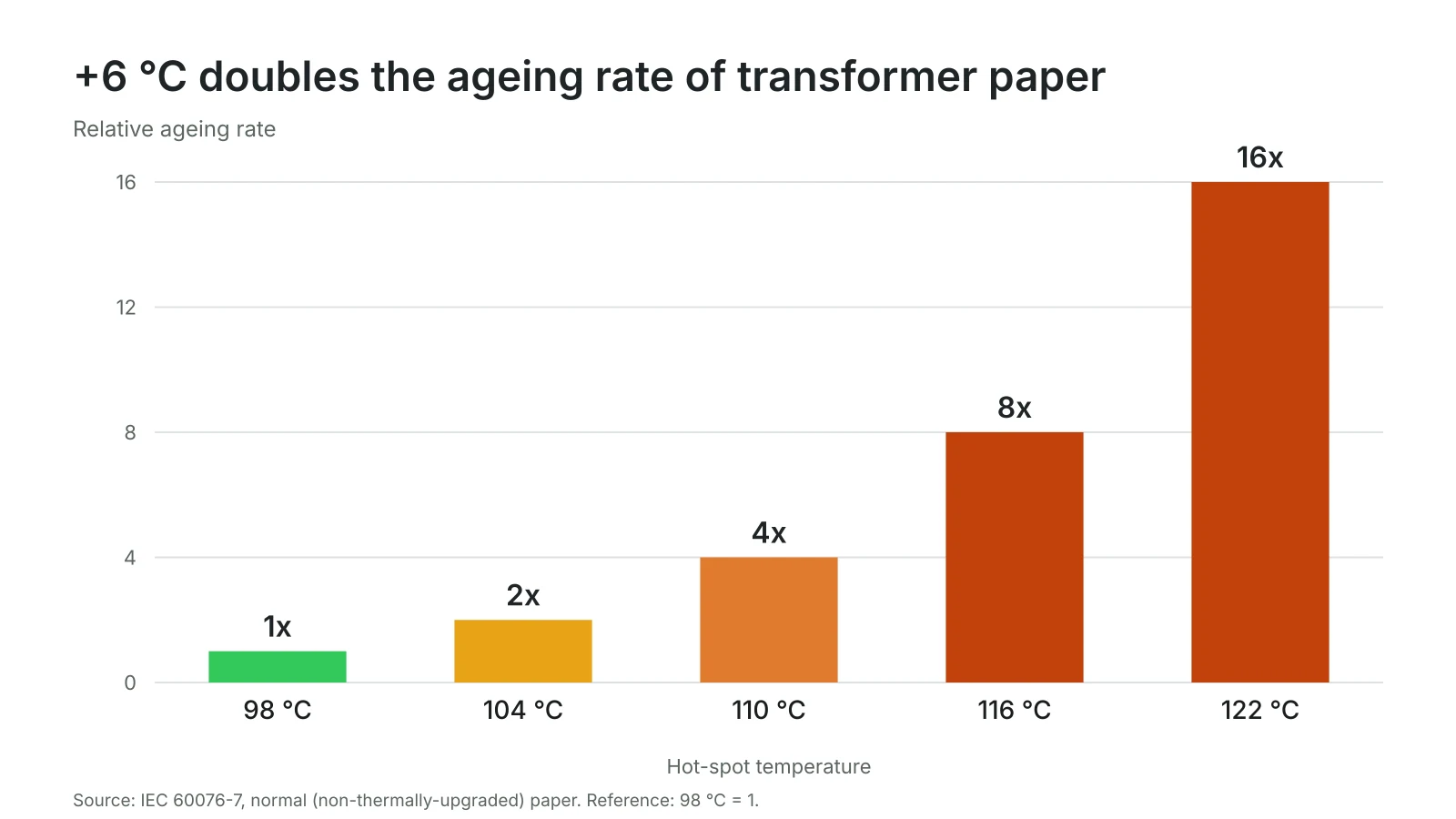
5. +6 °C doubles ageing
Per IEC 60076-7, raising hot-spot temperature from 98 °C to 104 °C doubles the ageing rate of normal paper; at 110 °C it is four times faster.
Natural esters pull moisture out of the paper; the manufacturer reports up to 8x longer insulation life and up to 20% more load than mineral oil.
6. Transformer prices up 75% since 2019
The IEA reports power transformer prices up about 75% in real terms since 2019 and lead times for large units of up to four years, double 2021 levels.
7. A 30% shortfall in US power transformers
Wood Mackenzie expects 30% and 10% supply deficits for power and distribution transformers in the US in 2025. Power transformer demand is up 116% since 2019.
8. A USD 4.6 billion market by 2034
IMARC sizes the global transformer oil market at USD 2.8 billion in 2025, reaching USD 4.6 billion by 2034, with Asia Pacific holding 55.8%.
9. PCB transformers ran out of time in 2025
Under the Stockholm Convention, use of equipment with more than 50 ppm PCB had to end by 2025, with disposal by 2028. UNDP says most countries missed the 2025 target.
10. 5 million transformers, 30 years
FR3® natural ester has been used for over 30 years in more than 5 million transformers, with the manufacturer reporting no fires in FR3®-filled units.
What it means
Transformers are scarce, fires are costly and regulation is tightening. The common answer is a high-quality K-class ester fluid plus regular oil analysis. Read our Transformer Oil Guide or see FR3®, FR3r™ and SE3®, supplied worldwide by Oilsan and produced in Dilovası, Türkiye.
Sources
- Hayes substation fire (North Hyde, 2025) and NESO reports
- Risk Equals Probability Times Consequences – T&D World
- IEA (2025)
- Wood Mackenzie (2025)
- pv magazine USA (2026)
- IMARC: Transformer Oil Market
- UNDP: Eliminating PCBs (2025)
- IEC 60076-7 ageing rates, IntechOpen
- Cover photo: Mario Amé / Pexels
Frequently Asked Questions
Why is transformer oil important?
Transformer oil insulates and cools oil-filled transformers and protects the cellulose paper that sets their life. Moisture, oxidation and heat accelerate paper ageing; per IEC 60076-7 the ageing rate roughly doubles for every 6 °C rise in hot-spot temperature. Mineral oil is also combustible and can fuel a fire after an internal fault.
How often do transformer fires happen?
Industry data put serious transformer failures at about 0.5–2.5% per transformer per year and serious fires at 0.06–0.1% per year, meaning 2.4–4% of transformers may cause a fire over a 40-year life.
What caused the Heathrow substation fire?
On 20 March 2025 a transformer holding about 25,000 litres of cooling oil burned at North Hyde substation, closing Heathrow for about 16 hours. NESO found excess moisture in components, a fault known since 2018 left unrepaired, and a fire suppression system inoperable since 2022.
Are ester transformer fluids safer than mineral oil?
For fire, yes. Mineral oil has a fire point of about 160–170 °C; natural and synthetic esters exceed 300 °C and are K-class less-flammable fluids. They are also readily biodegradable and tolerate moisture better.
Where can I buy ester transformer fluids?
Oilsan supplies FR3® Natural Ester, FR3r™ Natural Ester and SE3® Synthetic Ester across Türkiye and worldwide. They are produced in Dilovası, Türkiye. Call +90 212 909 93 36 or email info@oilsan.com.